
Auburn Previous Residents by Era
A house trail changes with the period under study. Modern parcels point to deeds. Fire-insurance maps supply building context near the turn of the twentieth century. One verified city directory bridges the interwar period, while census schedules and newspapers broaden the household picture.
| Source | Years It Covers | Where Held | What It Shows |
|---|---|---|---|
| Recorded deeds | Local start and imaging cutoff not published | Lee County Probate Recording Division | Owners, transfers, descriptions, prior references |
| Auburn Sanborn maps | 1897, 1903, 1909, 1919, 1928 | Library of Congress | Building footprint, material, use, street, lot context |
| Polk Auburn directory | 1923 | Auburn University and Internet Archive | Names, spouse, occupation, affiliation, residence notation |
| Federal census | Decennial schedules public through 1950 | Archives and library databases | Households and later street addresses |
| Local newspapers | Samples from 1853; strong runs from 1922 and 1937 onward | Auburn University holdings | Moves, sales, deaths, probate, social notices |
| Glomerata | Print from 1897; digitized 1897-2003 | Auburn University | University people, groups, and local advertisers |
Begin with the newest source that identifies the correct parcel. Then work backward. Add a directory or census entry only after the address, person, date, and surrounding evidence fit the same trail.
Start Auburn Address History Today
The current parcel provides the bridge into older land records. Auburn's parcel service can expose the owner, situs and mailing fields, PIN, prior owner, deed date, deed book and page, subdivision and lot, acreage, and homestead code. Situs means the physical parcel location. The mailing address is where the owner receives tax correspondence. A difference does not prove who occupies the building.
Record the parcel identifiers exactly. City geometry may update sooner than county ownership attributes, which enter the city layer quarterly. After a recent sale or split, compare the Lee County Revenue Commissioner search and ask appraisal staff when the systems disagree. This first step identifies land and a current owner, not who lived here before.
Reverse the Lee County Deed Chain
The Lee County Probate Recording Division keeps deeds, mortgages, liens, plats, releases, judgments, and other permanent instruments. No public web grantor-grantee index or coverage cutoff was verified. Public viewing stations are at 215 South 9th Street in Opelika, Monday through Friday from 8 a.m. to 4:30 p.m. Staff can assist with a name search. Mail copies require book, page, and recording date. Copies cost $1 per page, with $3 added for certification.
- Copy the current owner, deed book and page, legal description, subdivision and lot from the parcel record.
- Retrieve that deed at the Probate viewing station or request it by mail.
- Record the grantor, grantee, dates, prior-record reference, and full legal description.
- Search the seller as a grantee to locate the deed by which that seller acquired the land.
- Repeat while matching the legal description. Add household sources only after the land chain is stable.
- Grantor
- The party conveying an interest in the property.
- Grantee
- The party receiving that interest.
- Chain of title
- The linked sequence of recorded transfers for the same land.
- Legal description
- The recorded land identity, often a subdivision and lot or measured boundaries.
The Lee County Historical Society is a local contact for historical context beyond the official deed chain.
Historical society material may interpret a place, but ownership claims still need Probate instruments.
Five Maps Bridge Auburn Residents
Auburn has five verified Sanborn fire-insurance editions: 1897, 1903, 1909, 1919, and 1928. They can show building footprint, construction material, use, street alignment, and lot context. This helps because a deed transfer does not date the structure standing on the land.
Use a short evidence flow: legal description to historic lot, lot to mapped building, building to period street, and street to directory, census, or newspaper evidence. A map labels property features. It does not name each resident.
The Library of Congress Auburn Sanborn collection is the verified online route. Its manifest capture failed, so no substitute image is presented.
Auburn Previous Residents in 1923
The 1923 R. L. Polk volume is the verified directory bridge. Auburn appears on pages 151 through 180 of the digitized Opelika directory, with a shared classified section on pages 207 through 244. Entries may provide a surname, given name, spouse, abbreviated occupation, employer or institution, and an h residence marker.
Many Auburn entries say only “h Auburn.” That confirms local presence, not a street number. The contents list an Opelika Street and Avenue Guide and Directory of Householders, but no separate Auburn reverse-householder section was verified. Past residents cannot be assigned to an address from an assumed section that may not exist.
- Search the 1923 volume for the candidate and spelling variants.
- Note spouse, occupation, institutional link, and residence wording.
- Compare the person with the 1920 and 1930 censuses.
- Use deeds, newspapers, probate, or yearbooks to connect the household to the exact address.
The collections are covered more fully in the Auburn city directory. An asterisk marked Black residents in this segregated-era volume. That is evidence of biased historical indexing, not a label to repeat casually.
Federal population schedules add a wider household frame. Schedules from 1850 onward generally name household members, while 1790 through 1840 usually name only the head. Most 1890 schedules were destroyed. Public access now extends through 1950 under the 72-year rule. Street addresses become more useful in later schedules, but census spelling, house numbering, and district boundaries still need to be reconciled with the deed and map trail.
Search Auburn Streets Under Both Names
A street address is not fixed forever. In late nineteenth-century Auburn, Old Main became North College, and Church became North Gay. Search the old and current names in maps, newspapers, deeds, and directories. Keep the parcel description constant while testing each street form.
Annexation can shift the record keeper. Auburn's official map separates annexation polygons from current city limits, while the planning jurisdiction reaches beyond incorporated land. A postal “Auburn” line may not prove that the site was inside the city when a permit or civic record was made. Compare the map era, municipal boundary, county parcel, and address authority.
A modern-address query can therefore miss previous residents. The apparent gap may be a change in indexing, not a break in the people or place.
Before Lee County Kept Records
Lee County was created on December 5, 1866 from parts of Macon, Russell, Chambers, and Tallapoosa counties. Auburn-area land, court, probate, and census evidence from before that date may be filed under a predecessor county. Opelika became the seat for the new county system.
The first courthouse was built in 1867 by Horace King. The courthouse in use today replaced it in 1896. The state archives fire list did not surface Lee as a fire-loss county, but that is not enough to claim every early series survives.
The Alabama Department of Archives and History microfilm database searches by county and one record type. Groups can include deeds, wills, estates, marriages, guardianships, and limited birth or death registers. Exact Lee runs need a live catalog query. Earlier work first needs the county that governed the land.
Close Auburn Trails with Life Records
Newspapers, probate files, death records, and cemeteries can show where a household trail ends. Auburn University holdings include Auburn Plainsman material from 1922, Lee County Bulletin from 1937 through 1968, later successor titles, and Opelika-Auburn News microfilm from March 1969 through December 2018. Search for moves, sales, obituaries, estates, and family names. Alabama death certificates are restricted for 25 years, and eligible requests use the official ADPH death certificate application.
A certificate may confirm a death and family details within its access rules. It differs from a Lee County probate file, which may identify a representative, heirs, real property, and notices.
The Auburn Cemetery Viewer searches names and birth, death, or burial dates.
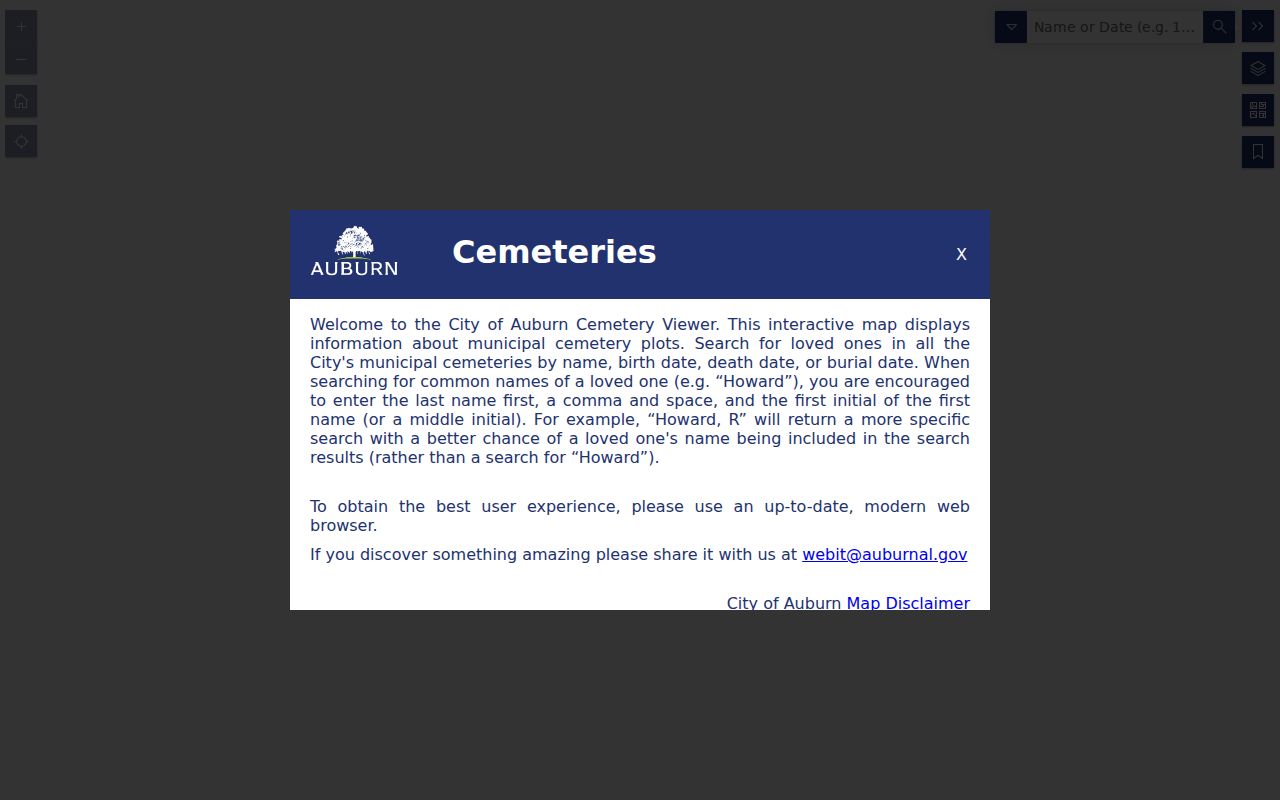
Nearby plots can suggest a family cluster, but burial proximity needs support from obituaries, certificates, census records, or probate. Pine Hill is a warning about gaps: it opened in 1837 and its oldest marker dates to 1838, yet early records do not survive and systematic survey began only in the 1950s.
Limits on Auburn Previous Residents
Ownership and occupancy are different facts. A deed names parties to a land transfer. A parcel roll names a tax owner. Neither lists every household member. The 1923 directory may establish presence in Auburn without a street number, and census work may require the correct enumeration district, the area assigned to one census taker, before an address is secure.
Several cutoffs remain unverified: the deed index start, bound-book or microfilm transition, permit archive start, complete annual directory run, and any surviving reverse-directory years. Those are real limits, not dates to estimate. Ask Auburn Public Library or Auburn University Special Collections about a named volume before visiting.
Auburn Public Library can be reached at (334) 501-3190 and searched through its online catalog. Auburn University Special Collections is on the ground floor of Ralph Brown Draughon Library at 231 Mell Street and can be reached at (334) 844-1732. Its verified 1923 Polk holding is in the Draughon Family Papers, Box 04, Folder 17. Contact staff with a title and year rather than assuming the shelf holds a continuous series.
Lawful use. Research on Auburn previous residents is suited to family history, house history, estate work, and personal curiosity. Do not use an address trail to locate, harass, threaten, or harm a living person. Confirm conclusions with the record custodian.