
Auburn Directory Collections by Year
Auburn's historical shelf is not an unbroken annual series. The best verified early volume is R. L. Polk & Co.'s 1923 Opelika book, which contains an Auburn section on pages 151 through 180 and a shared classified section on pages 207 through 244. A separate archival copy of Polk's Auburn City Directory is held in the Draughon Family Papers at Auburn University. Later regional books survive at the Alabama Department of Archives and History, but the research found only three Lee-Macon County dates rather than a continuous run.
| Collection | Years | Where Held | Access |
|---|---|---|---|
| Polk's Auburn City Directory | 1923 | Auburn University Special Collections | Open for research |
| Opelika directory, Auburn section | 1923 | Internet Archive | Free digitized volume |
| Lee-Macon Counties directory | 1998-1999 | ADAH, Box 129 | Archives research |
| Lee-Macon Counties directories | 2000 and 2002 | ADAH, Boxes 212 and 225 | Archives research |
| Reverse or criss-cross Auburn runs | Not verified | Ask local libraries and archives | Confirm before visiting |
No authoritative catalog exposed Auburn's first and last publication years, a complete year list, or a verified reverse-directory run. Advertisements that mention Auburn do not prove that a volume survived. Record the exact citation and repository for every book instead of filling missing years by assumption.
The 1923 Auburn Directory Online
The digitized 1923 Polk volume is the most direct remote access point. Its contents distinguish the Auburn alphabetical pages from Opelika's Street and Avenue Guide. That distinction matters: the table of contents does not identify a separate Auburn address-to-householder section.
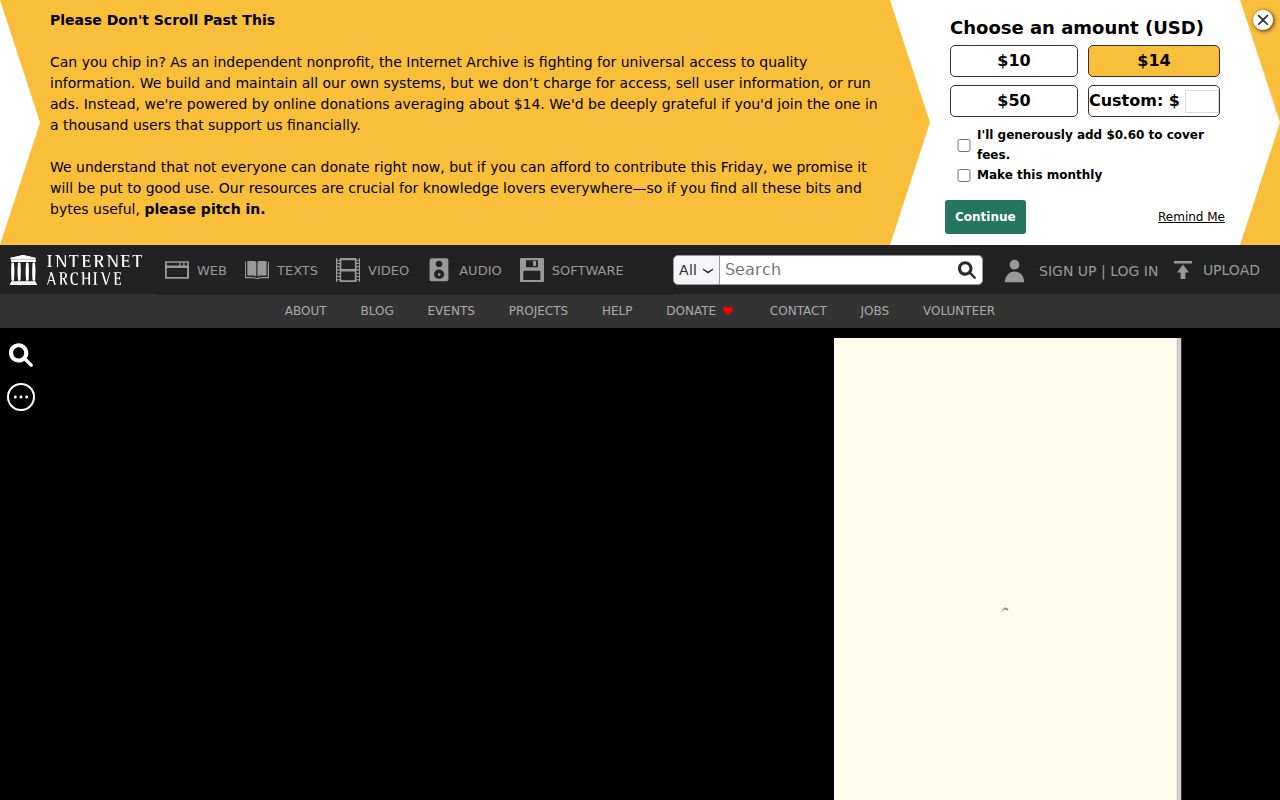
The image shows the actual online collection rather than a modern index. Search text can speed a name hunt, but page images, abbreviation pages, and nearby entries preserve context that optical character recognition may miss. Browse spelling variants and inspect the classified pages when an occupation or institution is known.
Reading an Auburn Directory Entry
A typical inspected line reads “Atkinson Thomas P (Irene), prof Auburn College, h Auburn.” It supplies a surname, given name and initial, spouse in parentheses, abbreviated occupation, institutional affiliation, residence marker, and locality. Nearby entries use “r,” “wid” followed by a deceased spouse's name, student ties, proprietor references, and institutional telephone numbers. These compact marks can distinguish two people who share a name.
| Name | Surname, given name, and sometimes a middle initial |
|---|---|
| Spouse | Name in parentheses when the publisher included it |
| Work clue | Abbreviated occupation, institution, or proprietor reference |
| Residence clue | “h” or “r,” sometimes followed only by Auburn |
| Widow notation | “wid” plus the deceased spouse's name |
An asterisk marked Black residents in this segregated-era publication. That convention is evidence about how the publisher organized the book, not a label to repeat without explanation. It also warns researchers that old directories can reflect exclusion, unequal coverage, and editorial practices of their time.
- Criss-cross directory
- A later directory format arranged by street or telephone number rather than only by surname.
- Householder index
- A street-order list that connects an address with the named householder shown by the publisher.
- Abbreviation key
- The volume's own guide to shortened occupations, residence marks, and other symbols.
Auburn Archives Preserve the Shelf
The archival copy belongs to accession 21-034 in the Draughon Family Papers 0162, Box 04, Folder 17. The Auburn University finding aid identifies it as open for research. Ralph Brown Draughon Library Special Collections is on the ground floor at 231 Mell Street. Researchers can contact the repository at (334) 844-1732 or archives@auburn.edu before a visit.
The Alabama Department of Archives and History catalog and research room adds the later Lee-Macon directories and county microfilm. Its microfilm database searches by county and a single record type. Originals usually remain with the office that created them, so a catalog result may point onward rather than supply a scan.
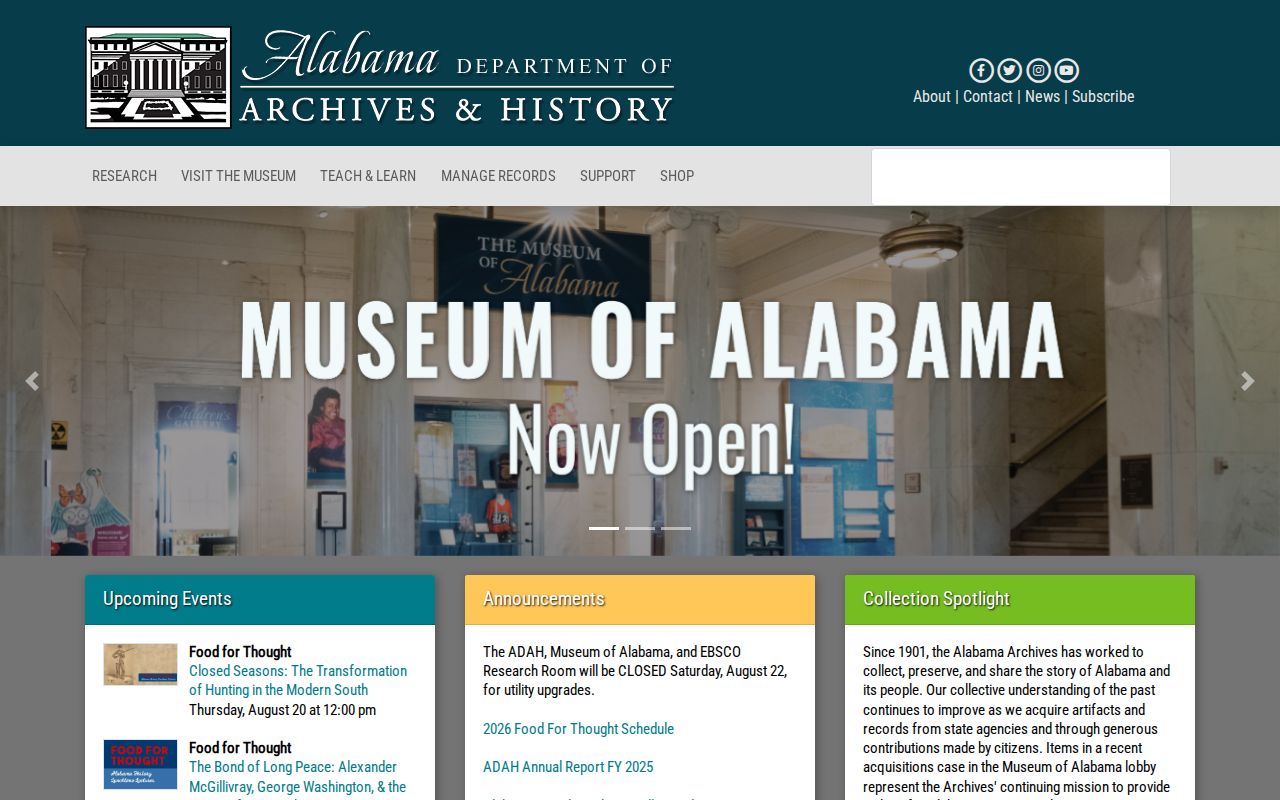
The archives view is useful for planning that second step. Research-room access also includes Ancestry, Fold3, Newspapers.com, HistoryGeo, and enhanced FamilySearch, allowing one directory clue to be checked against probate, land, newspaper, and family-history sources.
Auburn Library Directory Leads
Auburn Public Library's catalog is the local starting point for books and supporting sources. The library is at 749 East Thach Avenue and can be reached at (334) 501-3190 or weblibrary@auburnal.gov. Published hours are Monday through Thursday 8:30 a.m. to 8 p.m., Friday and Saturday 8:30 a.m. to 5 p.m., and Sunday 1 to 6 p.m.
The catalog screen supports a precise title, publisher, or subject check before travel. No official page verified a dedicated genealogy room, obituary index, or complete directory shelf, so contact staff with the title and year rather than assuming a book is on open shelves. The library's NewsBank access, announced in 2022, covers current and archived text from more than 3,500 newspapers and can supply notices that explain a change between entries.
Trace Auburn Families Across Sources
A directory line is strongest when it bridges larger record intervals. Federal population schedules are public through 1950 under the 72-year rule. Schedules from 1850 onward generally name household members, while earlier schedules usually name only household heads. Most of the 1890 schedules were destroyed, which makes surviving directories and newspapers more important around that gap.
- Search the surname, spelling variants, initials, spouse, and known affiliation in the 1923 volume.
- Copy the whole entry and its abbreviation key. Note whether it gives a street or only “h Auburn.”
- Compare the household with the 1920 and 1930 census schedules, allowing for spelling and age shifts.
- Search newspaper notices, probate material, deeds, and university sources for moves, deaths, and family ties.
- Use a cemetery result or obituary as a closing clue, then obtain the official record when proof is needed.
Absence is not proof that a person left Auburn. A publisher could omit students, transient residents, marginalized households, or anyone not reached during canvassing. Confirm a modern address clue through the Auburn street directory workflow instead of stretching a historical entry beyond what it says.
Auburn's Long University People Trail
Glomerata gives Auburn an unusually long companion record. The print trail begins in 1897, and digitized editions span 1897 through 2003. The yearbooks name and picture students, faculty, clubs, ROTC units, athletics, fraternities and sororities, and local advertisers. A college affiliation abbreviated in Polk can therefore lead to a portrait, class, activity, or group page.
ArchivesSpace indexes more than 43 Auburn-related collections. These include city ordinances, family papers, Auburn community organizations, and records from Beth Shalom Synagogue, local churches, Rotary, and other civic groups. Such collections do not form a universal residents roll. They do widen the trail beyond commercial directory coverage, especially in a university city shaped by frequent student and faculty movement.
University names also changed. East Alabama Male College opened in 1856, became the Agricultural and Mechanical College in 1872, Alabama Polytechnic Institute in 1899, and Auburn University in 1960. Search the institution name used in the relevant era.
Auburn Directory Gaps in Newspapers
The Auburn University Lee County newspaper inventory documents an unusually broad bridge between sparse directory dates. Holdings include samples of the Auburn Gazette from 1853 and 1854, the Auburn Plainsman from 1922, the Lee County Bulletin from 1937 to 1968, the Auburn Bulletin from 1968 to 1983, and later Eagle titles. Opelika-Auburn News microfilm runs from March 1969 through December 2018.
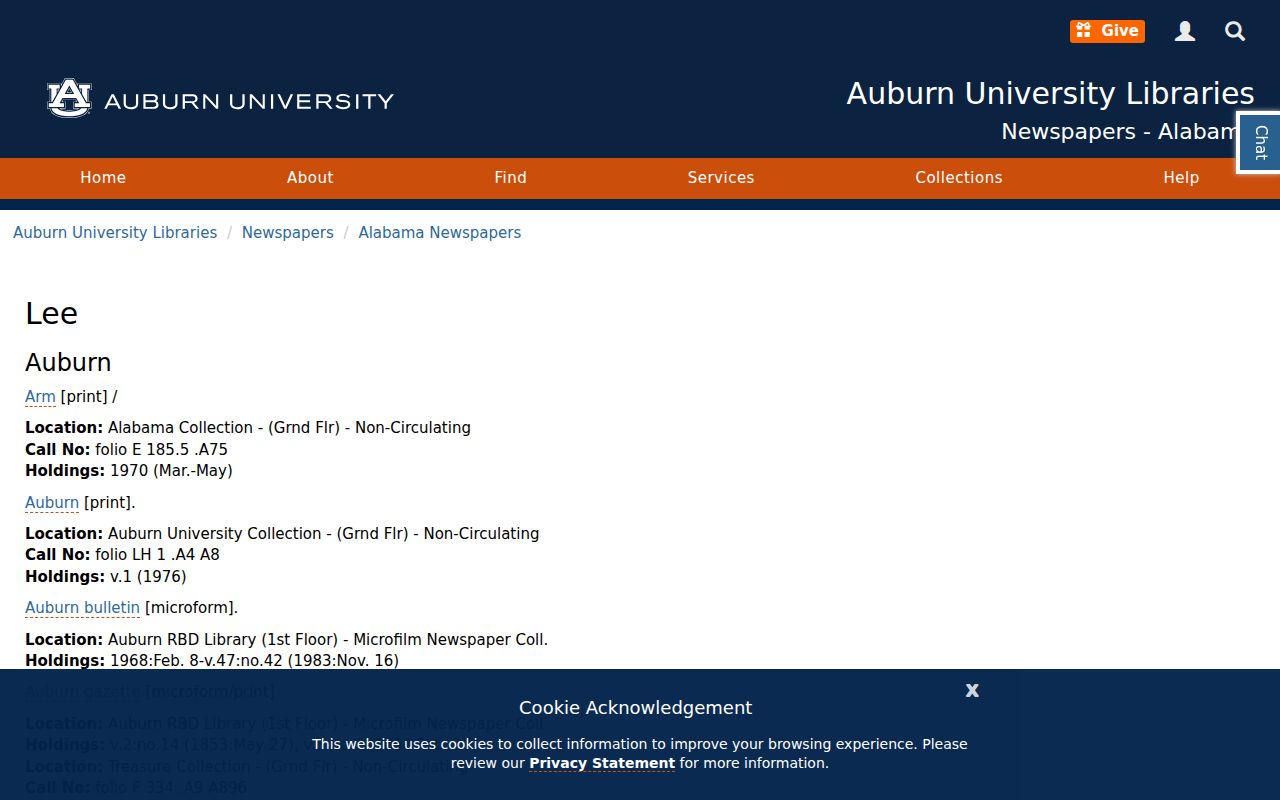
The holdings page tells a researcher which title and format to request. Birth and marriage notices, obituaries, sales, club reports, and school news can connect a person to relatives or a place when a city directory year is absent. Search within a tight date range and keep publication dates separate from the dates of events.
Auburn History Beyond Directories
The Lee County Historical Society's searchable newsletter index leads into Trails in History and regional historical organizations. The society is at 6500 Stage Road in Loachapoka. No formal paid research service or complete manuscript inventory was verified, so the index works best as a topic and surname lead rather than a promise that staff hold a given file.
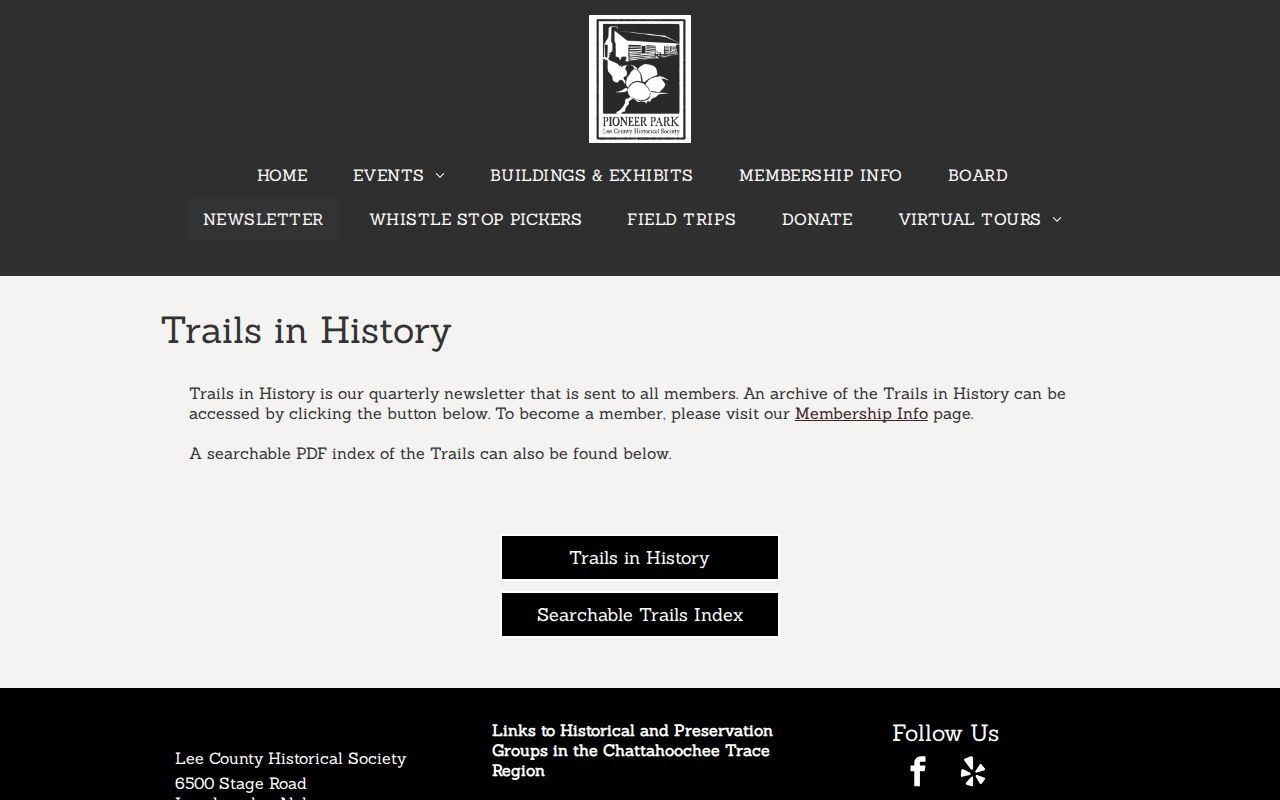
The index view adds local stories that may never enter a printed roll. Pine Hill offers one warning about gaps: the cemetery opened in 1837 and its oldest marked grave dates to 1838, but early records do not survive. A systematic survey began only in the 1950s and recorded more than 1,100 marked graves.
Pre-1866 research may shift outside Lee County. Lee was formed on December 5, 1866, from parts of Macon, Russell, Chambers, and Tallapoosa Counties. Earlier land, probate, court, and census evidence for an Auburn-area family may sit under one of those predecessor counties. That county change, incomplete directory runs, and lost cemetery records make source-by-source citations essential.